

Years of Infections and No Answers, and Then a Dante Labs Whole Genome Test Identified Alexander's Granulomatous Disease
Dante Labs Review Alexander
Dante Labs Review Alexander Square
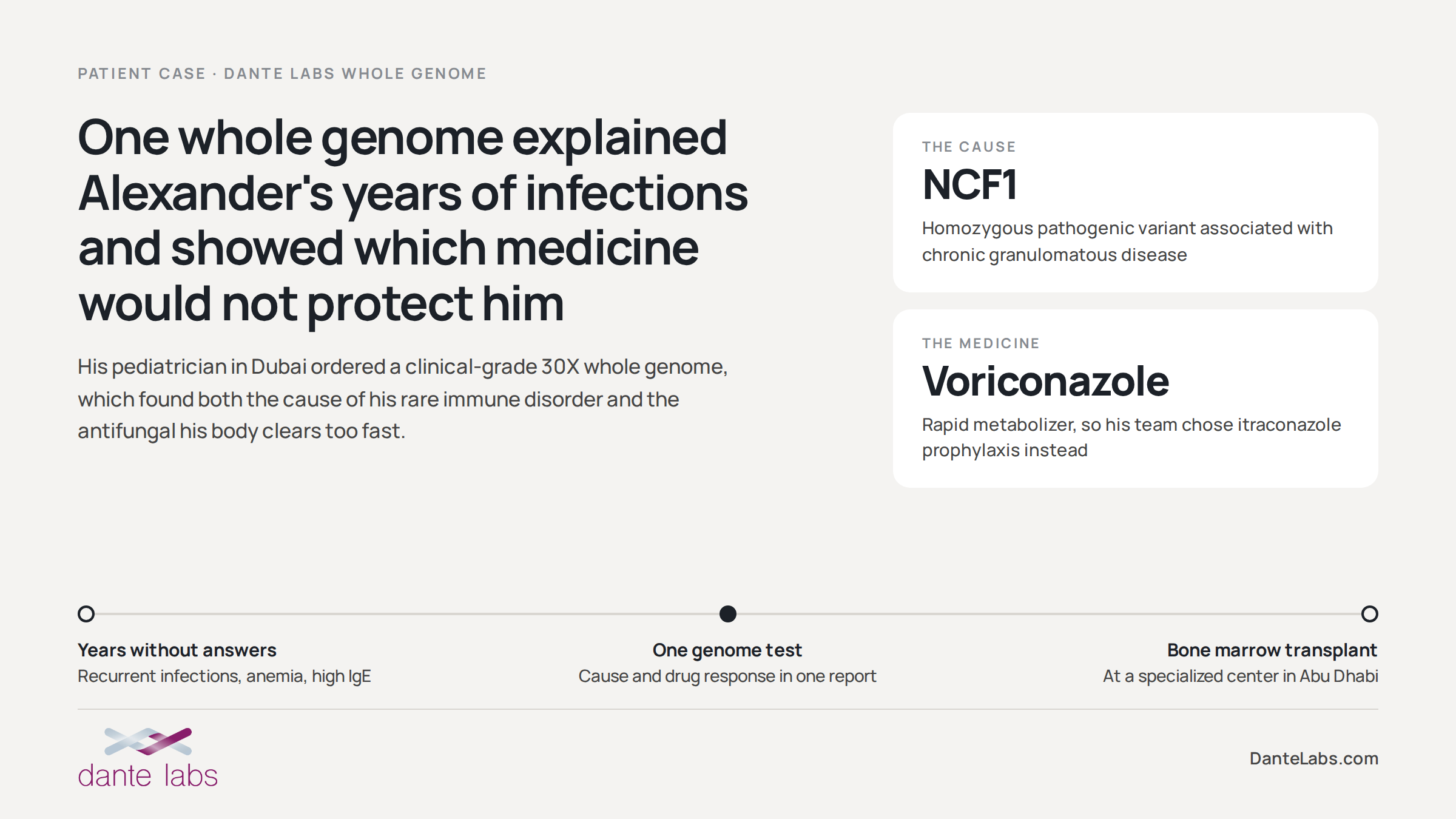
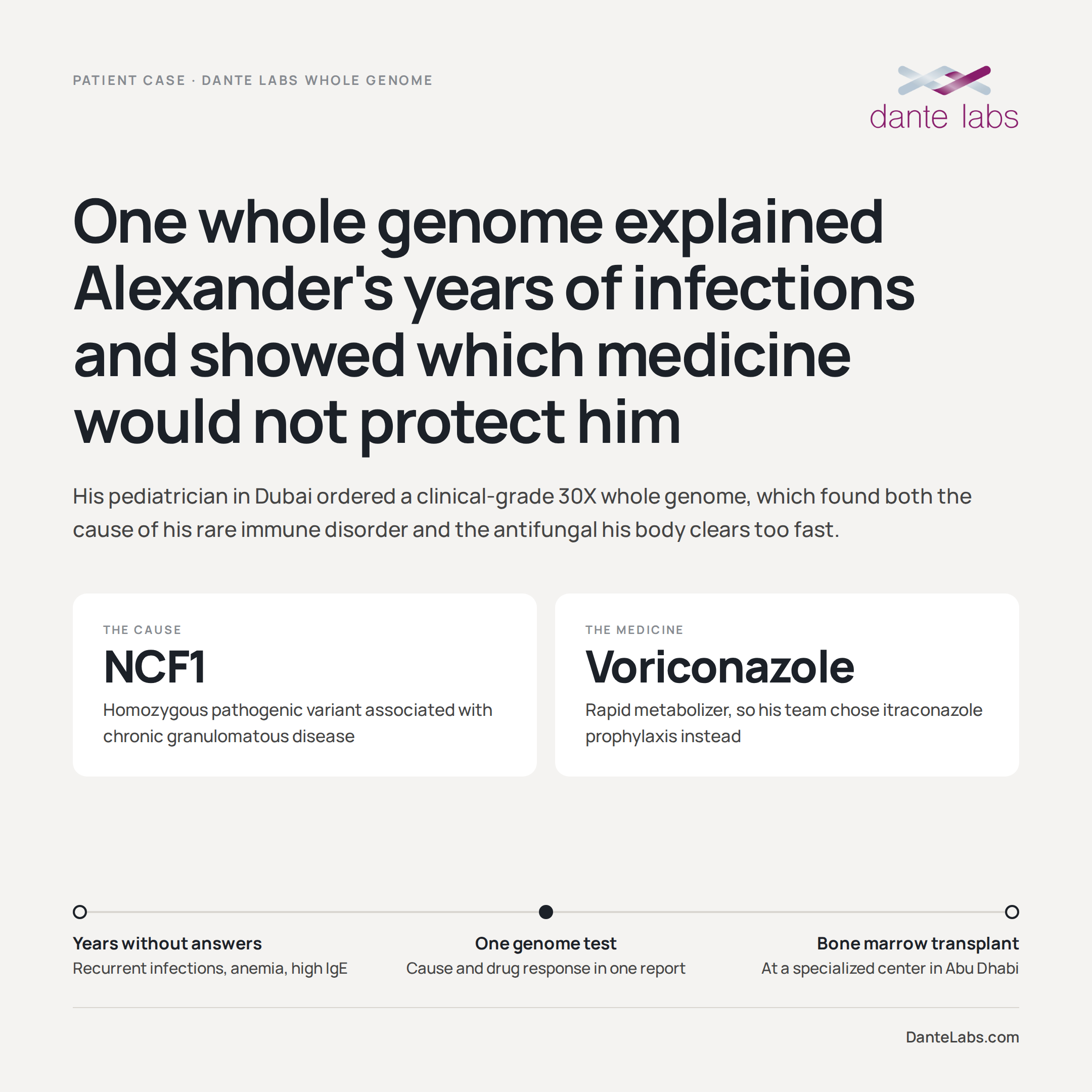
A variant in the NCF1 gene, a pharmacogenomic finding about voriconazole, in the Dante Labs reports provided a precise explanation and the path forward
NEW YORK, NY, UNITED STATES, October 21, 2026 /EINPresswire.com/ -- Alexander spent the first years of his life moving from one infection to the next, beginning with recurrent skin infections in infancy and followed by dysmorphic features, blood tests showing unusually high antibody levels and an anemia that iron supplements could not correct, yet none of the explanations his doctors considered accounted for everything they were seeing. Dante Omics AI announced today that a Dante Labs Whole Genome test, ordered through DanteLabs.com by Alexander's pediatrician, Head for Paediatric Genomics at a top hospital in Dubai, identified a homozygous pathogenic variant in the NCF1 gene associated with chronic granulomatous disease, a rare inherited immune disorder in which white blood cells cannot destroy certain bacteria and fungi, and that the same genome showed the antifungal most commonly relied on in this condition was unlikely to work for him.
Alexander was born with a rare recessive gene variant. As his symptoms accumulated without a unifying explanation, and as his parents grew increasingly frustrated by the absence of answers and of care that matched his needs, they brought him to a top local private hospital, where the medical team repeated several earlier tests and found elevated levels of the antibodies IgE, IgG and IgM together with a chronic anemia that had not responded to iron therapy.
Hyper IgE syndrome, another rare immune disorder, was initially considered, but Alexander's normal eosinophil count and the absence of eczema made it an unlikely fit, and the medical team concluded that the clinical picture was more complex than any single targeted test could resolve. Rather than ordering a succession of gene panels, each examining a limited list of candidate genes and each capable of returning another inconclusive result, he chose to examine Alexander's complete genome in one test.
Alexander's DNA was collected with a non-invasive kit designed to be suitable even for newborns and sequenced through the Dante Labs Whole Genome test, which reads the full genome at clinical-grade 30X coverage. The analysis identified a homozygous nonsense variant in exon 7 of NCF1, a change that stops the gene's instructions before the protein is complete and that is classified as pathogenic in the ClinVar database, where it is associated with chronic granulomatous disease type 1. NCF1 encodes one component of the NADPH oxidase complex, the enzyme system that immune cells called phagocytes use to produce the burst of reactive oxygen they need to kill the microbes they engulf, which explained why Alexander's body had struggled for years to clear infections that most children overcome.
Alexander's physicians confirmed the finding with flow cytometry and oxidative burst testing, both of which showed the abnormal oxidative burst that characterizes the disease, and further investigations uncovered chronic fungal abscesses in his spleen, an indication of how far the infections had progressed while the underlying cause remained unknown.
The same genome carried a second answer that proved just as consequential for his care. The pharmacogenomic report included with the Dante Labs Whole Genome identified Alexander as a rapid metabolizer of voriconazole, an antifungal widely used against the invasive fungal infections that threaten people with chronic granulomatous disease, which means his body clears the drug so quickly that it was expected to remain ineffective even at high doses. With that knowledge in hand before voriconazole became the treatment his care depended on, his team started antifungal and antibacterial prophylaxis with itraconazole instead, sparing him a therapy that would likely have failed at a moment when fungal abscesses had already formed.
With a clear genetic explanation for his condition, Alexander was able to undergo a bone marrow transplant at a specialized center, the one established therapy that replaces the blood-forming stem cells responsible for the defective immune response in chronic granulomatous disease, and which gives him the chance of a complete recovery and of a healthier childhood than his first years allowed.
"We provide powerful tools to doctors for their patients," said Andrea Riposati, CEO of Dante Omics AI. "We work together to save lives."
Chronic granulomatous disease is estimated to affect approximately 1 in 200,000 to 250,000 people worldwide, and those who carry it typically face serious bacterial or fungal infections of the lungs, skin, liver and lymph nodes, along with inflammatory complications such as granulomas in the digestive tract. Because its early signs overlap with more common immune and inflammatory conditions, many children, as Alexander did, pass through repeated hospital admissions and treatment-resistant infections before the cause is identified, which is why his case underscores the value of genome screening early in life, particularly in families and communities where marriage between relatives is common and recessive conditions are more frequent.
Key Facts
1) Patient: Alexander, a young boy with recurrent skin infections, dysmorphic features, elevated IgE, IgG and IgM, and chronic anemia that did not respond to iron therapy.
2) Physician: Head for Pediatric Genomics at a top private hospital in Dubai.
3) Test used: the Dante Labs Whole Genome test at clinical-grade 30X coverage, ordered through DanteLabs.com.
4) Reports: reports powered by the Dante Omics Versa Platform
5) Genetic finding: a homozygous nonsense variant in exon 7 of the NCF1 gene, classified as pathogenic in ClinVar and associated with autosomal recessive chronic granulomatous disease type 1.
6) Pharmacogenomic finding: rapid metabolism of voriconazole, which made the drug unlikely to work even at high doses, so his team used itraconazole prophylaxis instead.
7) Clinical confirmation: flow cytometry and oxidative burst testing showed the abnormal oxidative burst characteristic of the disease, and chronic fungal abscesses were found in his spleen.
8) Condition: chronic granulomatous disease affects approximately 1 in 200,000 people
Laura Rossi
Dante Omics AI
media@danteomics.com
Legal Disclaimer:
EIN Presswire provides this news content "as is" without warranty of any kind. We do not accept any responsibility or liability for the accuracy, content, images, videos, licenses, completeness, legality, or reliability of the information contained in this article. If you have any complaints or copyright issues related to this article, kindly contact the author above.
