

Unidata Launches a Network of Data-Capture Stations for Humanoid Robots
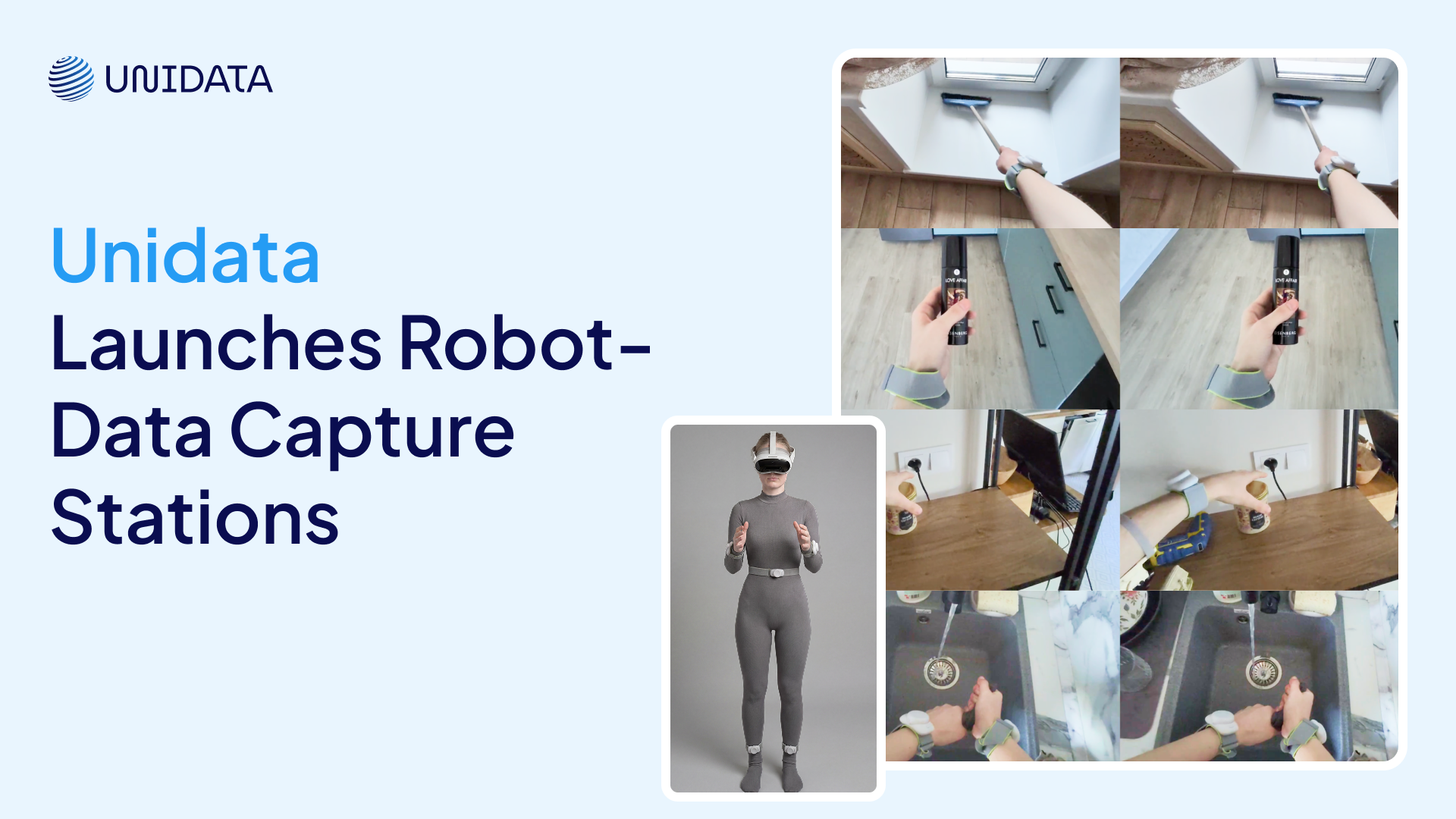
Egocentric Video Data Collection
Unidata has built stations designed to capture egocentric data for robotics: depth, touch, full-body and hand motion, recorded together in real interiors.
The industry is running into one problem across the board: volumes have to grow faster, but the diversity of the data has to keep up, and it's the quality of that diversity that really matters”
DUBAI, UNITED ARAB EMIRATES, August 14, 2026 /EINPresswire.com/ -- Nearly all egocentric video available for training robots is flat 2D: no depth, no camera pose, no record of physical contact. It is fine for pretraining and largely useless for the final stage. Data that carries depth, full-body motion, hand pose, and tactile signal together in ordinary rooms rather than a lab is rare, and rarer still at any real volume. Unidata has built a network of capture stations to close exactly that gap.— Kirill Meshik, Head of Data Collection
As humanoid platforms move out of the lab and into ordinary rooms, the data they need is the kind that's hardest to record: depth, motion, and contact, all at once. Unidata built its network to keep producing it.
The company now operates 45 stations across nine active sites, recording synchronized multi-stream egocentric data for humanoid-robot developers. Running at three daily shifts across the network, Unidata records on the order of 400 hours of this data per day. Each station is a self-contained rig designed to capture, on every take, the signals that public datasets leave out.
The build centers on the Pico 4 Ultra headset and its stereo camera, which supplies a depth map, metric distance to objects, per-frame camera position, and the lens parameters needed to reconstruct a scene. Motion trackers on the hands, feet, and waist build a real-time full-body skeleton; a monocular camera on each wrist recovers hand pose when an object blocks the built-in tracking. Unidata is also implementing tactile gloves that record pressure at the contact points, capturing grip and load that video cannot show. Building the tactile layer in from the start is itself unusual, it is the data teams most often add only after a model starts failing on real objects.
Across those stations, the operation has logged around 200 manipulation scenarios, including grasping, transfer, and handling objects that differ in mass and texture, with a typical scenario using 10 to 15 props chosen to vary how the hand makes contact. Episodes are capped at 20 minutes to keep tracking errors from accumulating, and every take is checked by automated scripts for frame-rate stability and stream synchronization before delivery.
About Unidata
Unidata is a UAE-based data collection and labeling company with 9+ years of experience. The company delivers end-to-end services, including collection, annotation, and delivery, with SLA-backed timelines and dedicated project managers. Unidata works with a global roster of enterprise clients, and its robotics practice builds multimodal datasets for humanoid-robot training.
Eugenia Trofimova
Unidata
e.trofimova@unidata.pro
Inside an Egocentric Data Station
Legal Disclaimer:
EIN Presswire provides this news content "as is" without warranty of any kind. We do not accept any responsibility or liability for the accuracy, content, images, videos, licenses, completeness, legality, or reliability of the information contained in this article. If you have any complaints or copyright issues related to this article, kindly contact the author above.
